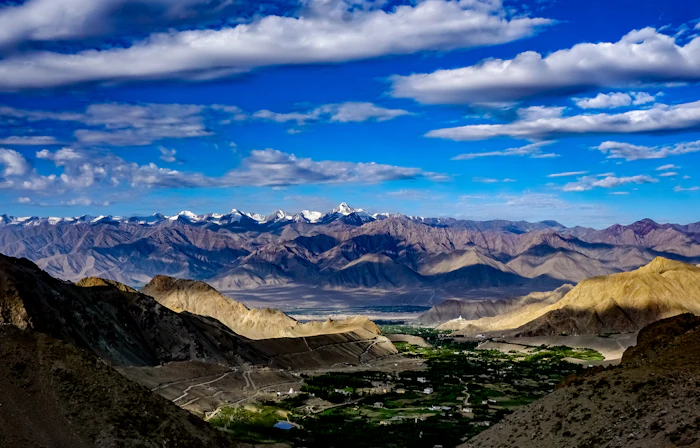
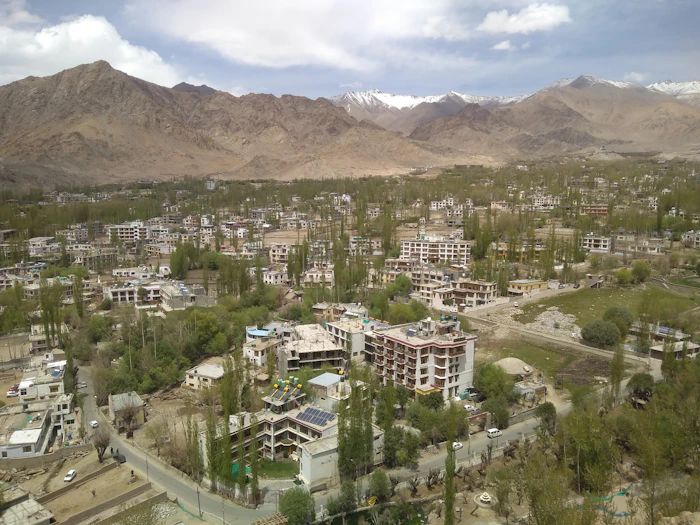
Leh sits at 3,500 metres in the Indus river valley, below a 9th-century palace on a hilltop and above the river that links it to Kashmir on one side and to the Tibetan plateau on the other — the most dramatically positioned capital of any Indian administrative region.
The altitude is not incidental to Leh's character but constitutive of it: the town exists at this elevation because the Indus valley here is hospitable enough to support agriculture — barley, wheat, apricots — while being high enough to control the trade routes between Central Asia and the Indian subcontinent that made Ladakh's medieval kingdom prosperous. The palace, built by the Namgyal dynasty in the 17th century and modelled on the Potala Palace in Lhasa, overlooking the bazaar that is still the commercial centre of town.
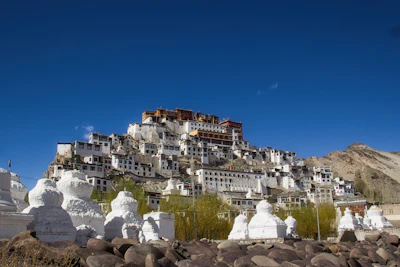
The monasteries within reach of Leh — Thiksey, Hemis, Spituk, Stok — operate on a circuit that rewards being spread over several days, since each has its own character. Hemis, the largest and wealthiest monastery in Ladakh, holds in its treasury a thangka of Padmasambhava 40 metres high, displayed only once every twelve years, and conducts an annual festival of masked dancing that draws visitors from across the world to watch performances of a theatrical tradition continuous for centuries.
Places to Visit in Leh
- Leh Palace
- Leh Market
- Shanti Stupa
- Thiksey Monastery
Things to Do in Leh
- Old town and market walk
- Sunset at Shanti Stupa
- Acclimatization day exploring Leh
Leh in Pictures
Tours Featuring Leh
Ready to experience Leh?
Tell us your dates and interests. A specialist will send a private itinerary built around Leh within 24 hours.
